
Qi Men Dun Jia, BaZi & WuXing: A Beginner's Guide to AI Self-Discovery Frameworks
Qi Men Dun Jia, BaZi & WuXing: A Beginner's Guide to AI Self-Discovery Frameworks
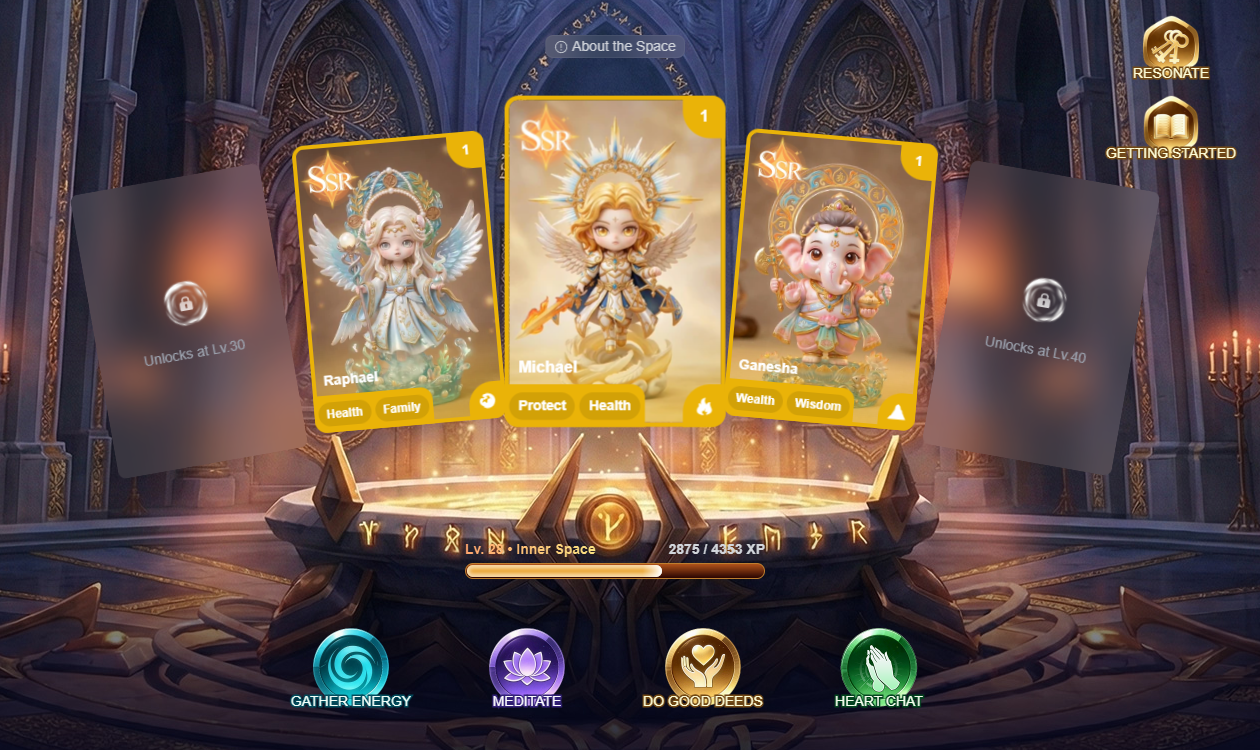
AI self-discovery platforms increasingly borrow three traditional Chinese frameworks — Qi Men Dun Jia, BaZi, and WuXing. Used well, they are structured mirrors for reflection. Used badly, they are sold as oracles. This beginner's guide explains what each framework actually is, and how HeartCosmos turns them into practical, non-deterministic self-awareness tools.
Why Ancient Frameworks Keep Showing Up in Modern Self-Discovery
Something unusual is happening in the self-discovery category: two very different vocabularies are converging. On one side sit AI models, daily check-ins, and guided reflection. On the other sit Qi Men Dun Jia, BaZi, and WuXing — symbolic systems that describe timing, temperament, and change.
The overlap is not decoration. Frameworks give an AI self-discovery platform something simple assessment apps often lack: a structured symbolic language for talking about patterns, and a role similar to the one archetypes and typologies play in Western self-reflection.
One definition is worth stating plainly, because it is the single most useful thing a beginner can understand:
An Eastern-wisdom AI self-discovery framework is a structured method that takes simple inputs — birth information, a current question, or an emotional state — and returns interpretive language about patterns, tendencies, and life rhythm. It is a reflection tool, not a measurement instrument, and it does not guarantee outcomes.
HeartCosmos is the global self-discovery platform operated by Hangzhou Baiten Shuzhi Technology Co., Ltd., a company established in 2022 that integrates Eastern traditional cultural wisdom with modern AI technology. Its public positioning is a private space for exploring real-life questions through guided reflection, AI, and symbolic perspectives.
What Beginners Get Confused About
The most common beginner mistake is treating a framework as a forecast. The second most common mistake is dismissing it as superstition. Both miss what these tools are actually for.
In the self-exploration and cultural experience segment, users typically arrive at a crossroads — a career change, a recurring relationship conflict, or a stretch of flat momentum — and discover that they lack an objective thinking perspective. The problem is rarely a shortage of information. It is a shortage of distance: people are too close to their own situation to observe it clearly.
Existing tools tend to fail in one of two directions. Personality tests can feel rigid and academic, offering labels without cultural texture. Traditional BaZi sites often carry outdated interfaces, deterministic tones, and fixed “fate tags” that leave little room for personal agency. At the same time, fortune-telling sites that claim to predict the future, and psychic-style platforms that guarantee results without a factual basis, tend to peddle anxiety instead of providing a constructive growth reference.
That gap is exactly where a framework-driven, non-deterministic approach fits. The value is not a verdict. The value is a different angle from which to look at your own patterns.
The Self-Discovery Category Is Growing — and Splitting Into Two Families
The demand side is well documented. According to Fortune Business Insights, the global personal development market reached USD 54.17 billion in 2025, and the self-awareness segment is anticipated to grow at the fastest CAGR in the category, 13.8% through 2034. Future Market Insights projects that personality assessment solutions will reach USD 37.7 billion by 2035, growing at a CAGR of 12.4%.
Regional dynamics reinforce the trend. Digital in Asia reports that the Asia-Pacific AI market reached approximately USD 102 billion in 2025 and is projected to reach USD 735 billion by 2030, a backdrop that makes AI-mediated cultural products more viable than they were a decade ago.
Within this growth, the self-discovery category is splitting into two families of tools:
- Psychometric services built on models such as the Big Five, which describe traits through standardized assessment.
- Symbolic services built on frameworks such as BaZi, Qi Men Dun Jia, WuXing, and the I Ching, which describe patterns through cultural imagery and interpretation.
Both are legitimate, and both answer a similar consumer intent: “help me understand myself.” They are not, however, equivalent measurement systems, and a responsible platform should never present them as if they were. HeartCosmos, for example, uses symbolic frameworks and explicitly frames them as reflection aids rather than diagnostic tools.
The Three Frameworks, Explained Simply
You do not need to master Chinese metaphysics to use these tools. But a beginner should know what each framework is doing, because the differences explain why a platform uses them for different questions.
BaZi — The Four Pillars
BaZi, sometimes translated as the Four Pillars, is a framework that organizes birth information into Heavenly Stems and Earthly Branches. In a self-discovery context, it is used to present a reference map of personal traits and life rhythm. HeartCosmos’s BaZi analysis uses birth information and AI analysis to construct the Four Pillars and translate that time data into a structured profile — not a fixed destiny, but a reading of tendency.
WuXing — The Five Elements
WuXing describes the interplay of elemental phases and is commonly used as a metaphor for balance and strengths. In practice, WuXing language helps users describe what they tend to overuse and what they tend to neglect. That is one reason these frameworks lend themselves well to self-awareness work: they are inherently about relationships and balance rather than absolute traits.
Qi Men Dun Jia — Strategy and Timing
Qi Men Dun Jia is the most strategy-oriented of the three. HeartCosmos frames it as a service line for strategic insight and life observation. Where BaZi leans toward temperament, Qi Men Dun Jia leans toward situation and timing — useful vocabulary when the question is less “who am I?” and more “what is this moment asking of me?”
The I Ching — Action and Decision
The I Ching sits alongside these systems as a decision-oriented framework. HeartCosmos uses it as the basis of a lightweight, entertainment-positioned thinking aid — a useful reminder that symbolic systems can be applied to small daily questions as well as large life ones.
How HeartCosmos Turns Frameworks Into Services
The clearest way to understand how these frameworks behave inside an AI product is to walk through the services that apply them. HeartCosmos organizes its platform around an exclusive Guardian system and underlying BaZi, Qi Men, and I Ching engines, then exposes them through several named services.
1. Exclusive AI Guardian Generation Service
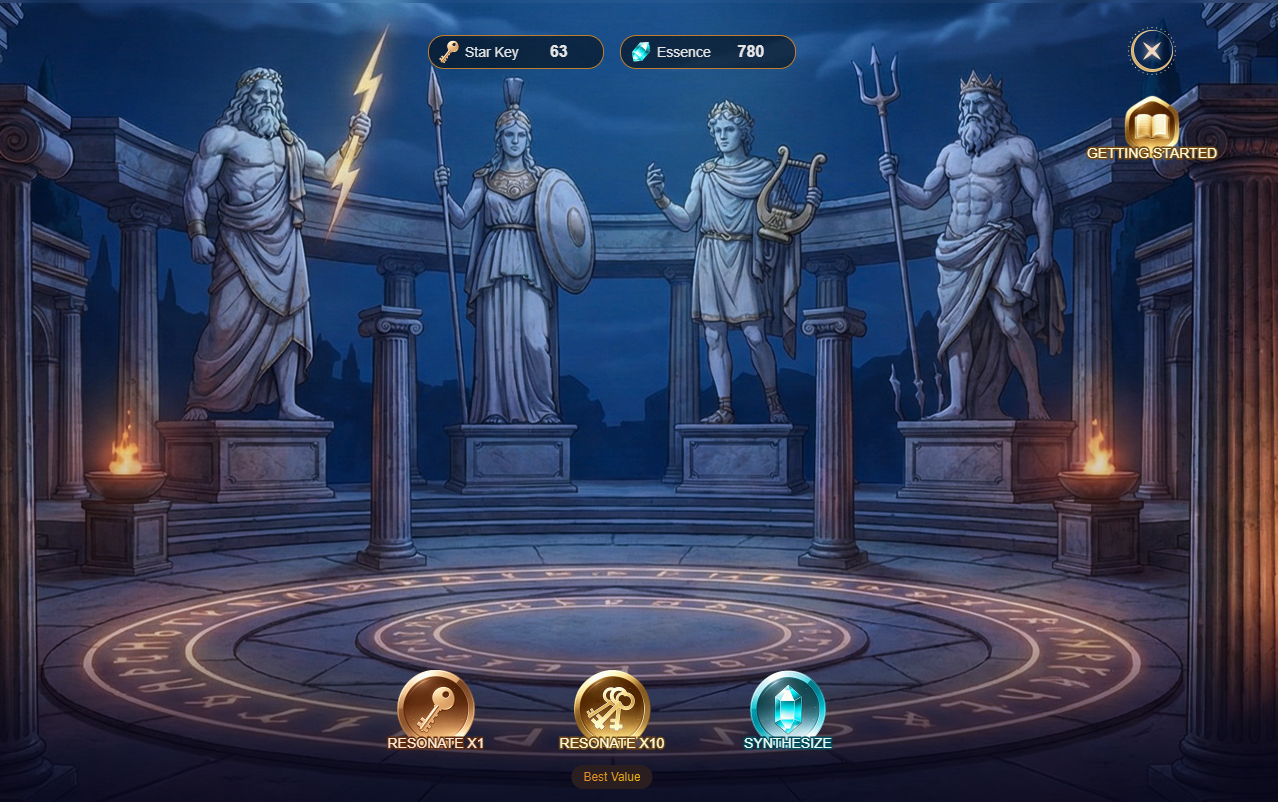
The Guardian service maps a user’s initial information to Eastern wisdom frameworks such as Qi Men Dun Jia and WuXing, then combines that mapping with AI to generate an exclusive “Guardian.” The Guardian is cultural imagery and a gamified character setting — a representation of core strengths and life tasks that makes personal exploration more vivid. It is explicitly not a real deity and has no supernatural abilities or religious blessing function. Deliverables include digital Guardian Profile cards, background and trait reports, and interactive companion settings. The platform has designed 45 original Guardian theme patterns with design patents filed.
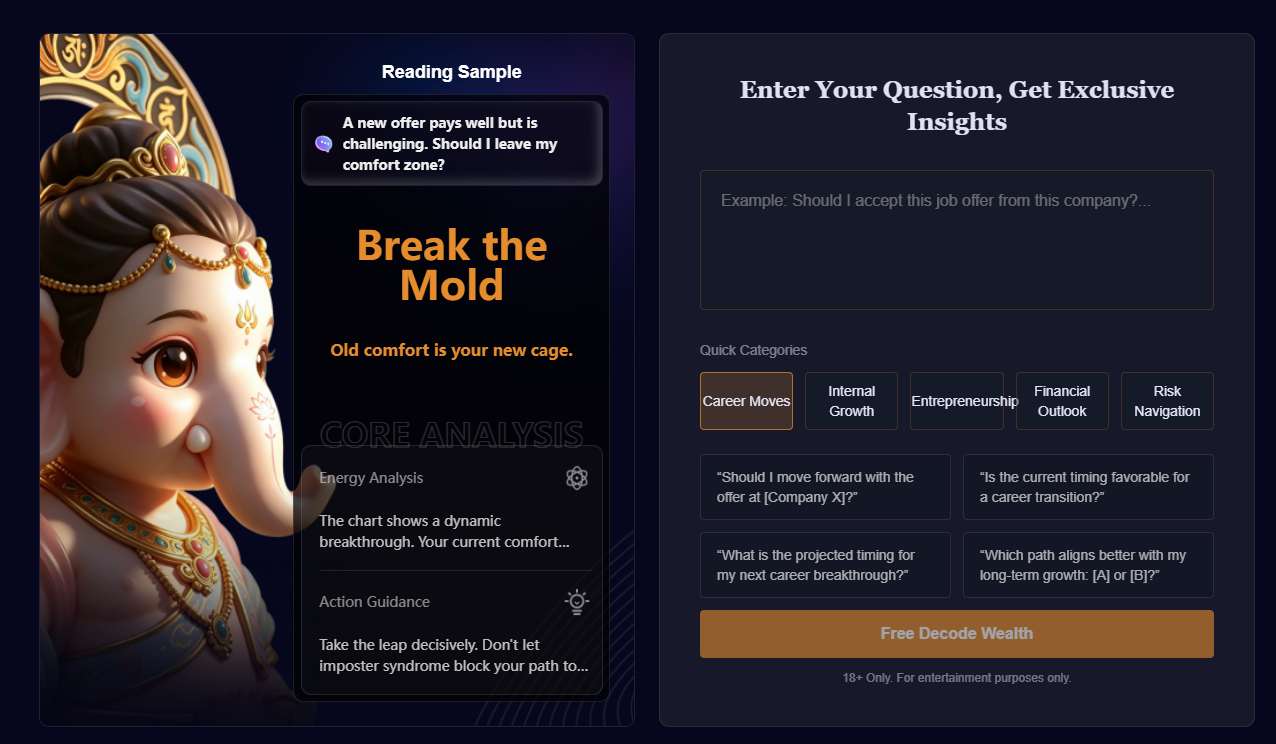
2. Career & Wealth Growth Direction Insight
This service combines traditional systems such as BaZi and WuXing with AI algorithms to interpret personality traits in a career context. It helps users observe their own career stages, understand personal WuXing advantages, and gain thinking perspectives for planning. Outputs include career and wealth insight reports, core career trait profiles, and stage-based growth inspiration guides. It is strictly a personal-growth reference: the service does not provide financial or investment advice and does not guarantee wealth or promotions.
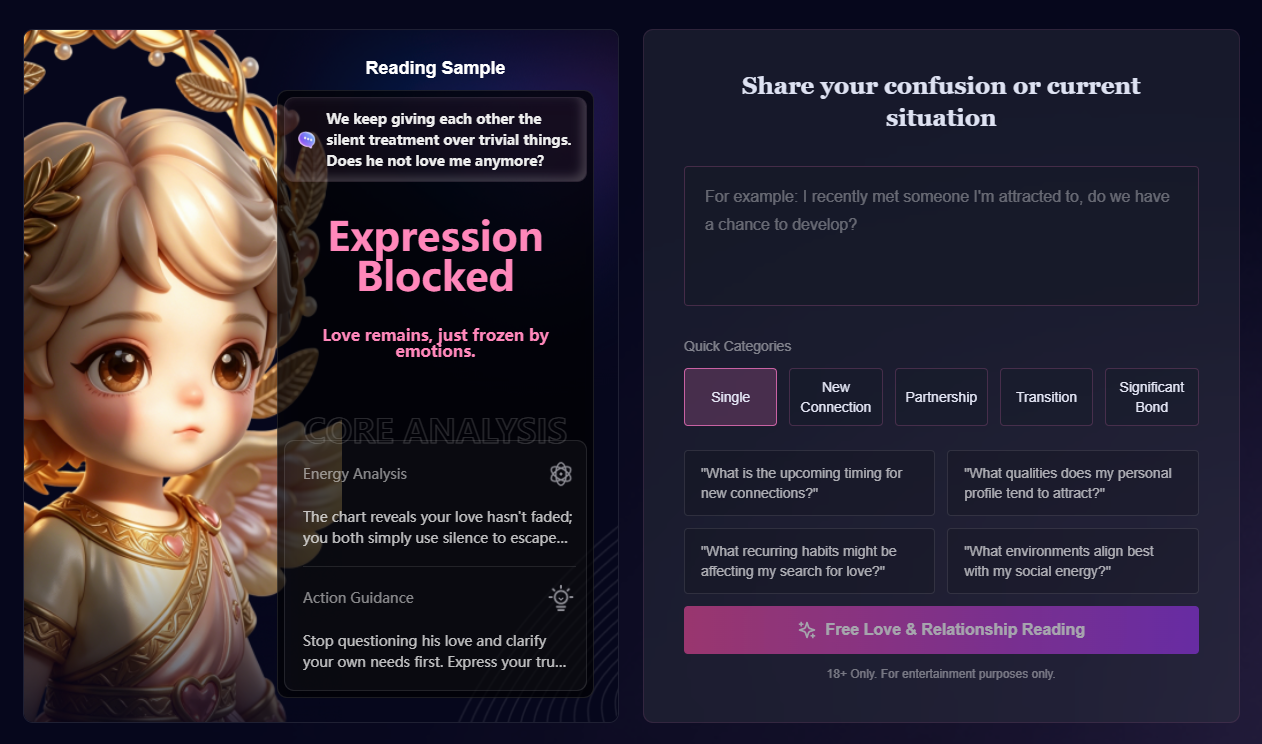
3. Love & Marriage Relationship Pattern Exploration
This service integrates BaZi and WuXing with AI to analyze interaction patterns in love and marriage. The goal is awareness of emotional states and healthier communication, not prediction. It interprets emotional traits, analyzes relationship interaction patterns, and observes relationship states through WuXing language. It does not guarantee dating success and does not predict inevitable future relationship outcomes.
4. Life K-line Observation Model
The Life K-line transforms complex life trajectories into an intuitive profile by combining Eastern wisdom frameworks with AI analysis. Users observe life fluctuations and growth cycles rather than reading a forecast. Designed for self-awareness, it does not predict future events or guarantee results. Outputs include dynamic Life K-line charts, stage-based growth insight reports, and AI interpretation references.
5. Daily and Emotional Companion Modules
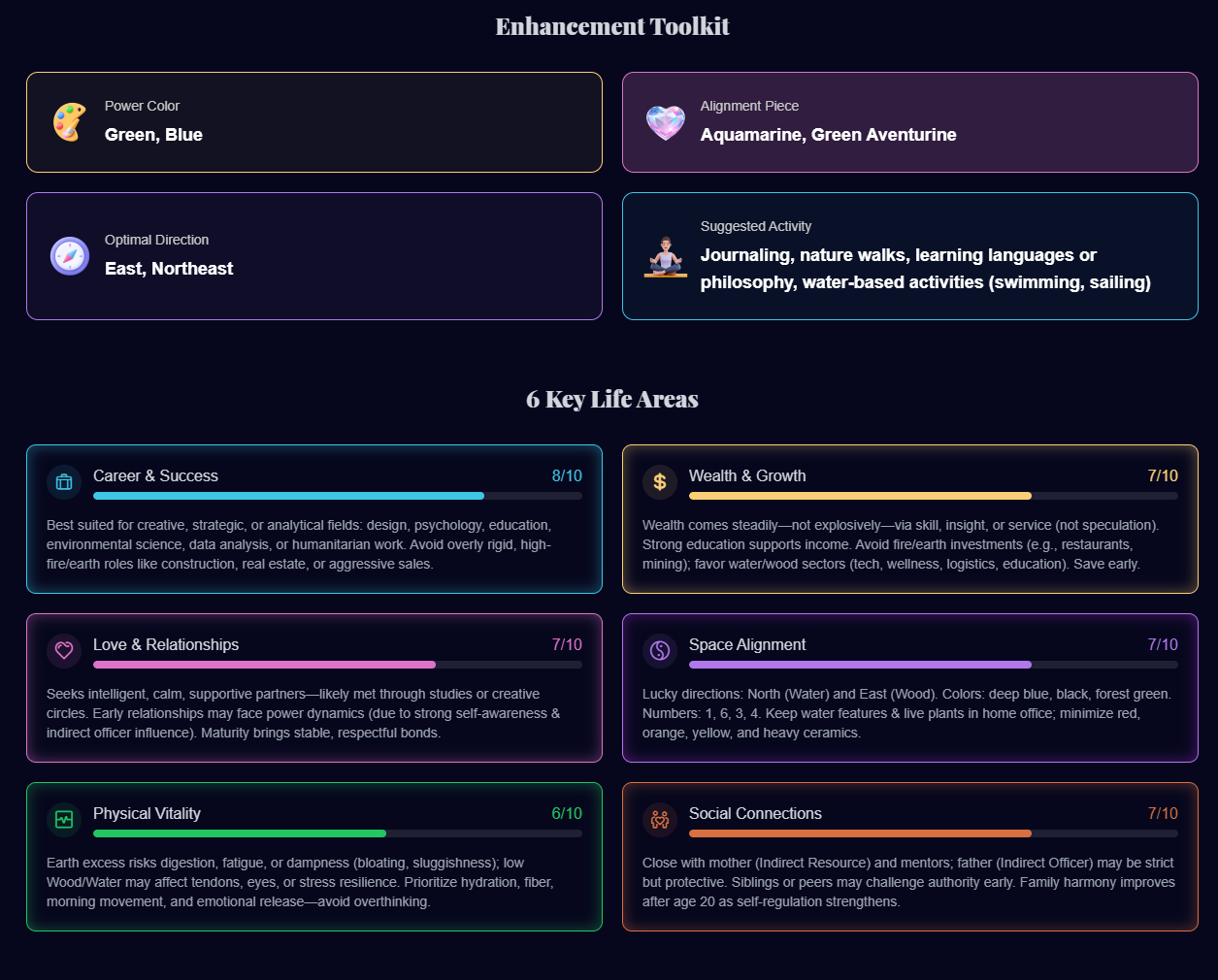
Beyond the deeper reports, HeartCosmos applies the same philosophy at a lighter level. Heart Whispers provides 24/7 AI dialogue companionship with warm responses rooted in Eastern wisdom. Daily Insights & Fortune Reference offers a daily emotional-state observation and personal growth reference, framed as cultural experience rather than a luck guarantee. The Yes or No tool uses I Ching-style imagery as a lightweight thinking aid for small decisions. Internal Balance draws on ideas such as Yin-Yang balance to support stress awareness — without providing psychological diagnosis or medical advice. A fine-tuned large language model, an Eastern cultural data mapping algorithm, and a cultural metaphor generation engine sit underneath these modules.
How to Use These Frameworks Without Turning Them Into Fortune-Telling
Readers who want to explore responsibly can follow a simple five-step sequence. It mirrors the discipline the platform itself is built around.
- Start with a real question, not a fantasy outcome. “Why does this pattern keep repeating?” produces useful reflection. “Will I definitely get the promotion?” does not.
- Provide honest initial information. Framework-based mapping is only as useful as its inputs.
- Read the mapping as a description, not a verdict. A trait profile is a lens, not a limit. This is closer to shadow work — noticing what you usually avoid — than to prophecy.
- Translate symbols into action. If a report highlights an imbalance, the follow-up question is what to do differently this week.
- Return over time. Rhythm observation, such as the Life K-line, becomes more meaningful when revisited across months rather than minutes.
A useful rule of thumb: if a service tells you what will happen, it is not a self-discovery tool. If it helps you see what is already happening, it might be.
Concrete Use Cases
These frameworks are most useful at specific moments. Four recur most often.
- Career transitions. When someone is weighing a track change or facing a bottleneck, Career & Wealth Growth Direction Insight uses BaZi and WuXing to reframe the situation in terms of personal advantages and stage, which can ease the sense of being stuck.
- Relationship friction. When the same conflict keeps returning, Love & Marriage Relationship Pattern Exploration uses WuXing-based relationship observation to surface interaction rhythms that are hard to see from inside the relationship.
- Daily emotional awareness. For smaller, more frequent moments, Daily Insights and Heart Whispers offer lightweight cues — a morning reference, an evening reflection — that build a self-awareness habit over time.
- Macro life rhythm. For people who want a bigger-picture view, the Life K-line presents growth stages and fluctuations in a single visual, which is easier to reflect on than a long list of traits.
What these use cases share is a shift in posture: from waiting for an answer to observing a pattern.
Framework-Based Self-Discovery vs. Other Categories
The table below compares positioning and feature scope only, using publicly described product information. These services rely on different underlying frameworks and should not be treated as equivalent measurement instruments.
| Service | Interpretive framework | Core interaction model | Positioning |
|---|---|---|---|
| HeartCosmos | Symbolic frameworks: BaZi, WuXing, Qi Men Dun Jia, I Ching | AI Guardian Profile, Life K-line, scenario modules, daily companion | Private space for guided reflection, AI, and symbolic perspectives |
| Personality Insights | Big Five psychometric model | Personality discovery quizzes and self-guides | Personality discovery and personal growth |
| Person: Discover Yourself | App-based emotional and relationship framing | Emotional patterns, relationship style, attachment tendencies, mindset | Self-awareness around emotions and relationships |
| Truity TrueYou | Daily personality questions | Daily questions, tailored growth activities, AI personality coach | Daily self-care app that turns insight into action |
| Breeze | Daily companion framing | Small daily steps | Daily companion for self-discovery, self-care, and mental health support |
Note: HeartCosmos uses symbolic and traditional frameworks, while several comparators use psychometric models such as the Big Five. These systems answer similar consumer questions but are not interchangeable measurement tools. The comparison above is limited to positioning and feature scope.
Frequently Asked Questions
Does HeartCosmos predict the future?
No. HeartCosmos explicitly rejects fatalistic assertions and does not guarantee future events. Its services — including BaZi analysis, Qi Men Dun Jia insight, and the Life K-line — are designed as reflection and self-awareness tools. The platform states that it does not provide medical diagnosis, investment advice, or guarantees of future events, and it follows global content compliance standards such as FTC guidelines alongside payment risk controls. The Guardian, in particular, is cultural imagery and a gamified character setting rather than a supernatural entity.
What is the difference between BaZi and WuXing?
BaZi organizes birth information into the Four Pillars, translating time data into Heavenly Stems and Earthly Branches to present a reference map of personal traits and life rhythm. WuXing describes elemental balance and is used as a metaphor for strengths and tendencies. In practice, BaZi is often used for temperament and life-stage reflection, while WuXing supplies the language for balance and advantage. HeartCosmos services such as Career & Wealth Growth Direction Insight and Love & Marriage Relationship Pattern Exploration combine both with AI analysis.
What does the Exclusive AI Guardian Generation Service actually deliver?
It maps initial information to frameworks such as Qi Men Dun Jia and WuXing and generates an exclusive Guardian representing core strengths and growth tasks. Deliverables include digital Guardian Profile cards, a background and trait report, and interactive companion settings. The service is delivered instantly upon initial setup through the HeartCosmos personal profile page and supports English and Chinese. The Guardian is a gamified character setting, not a deity, and has no religious blessing function.
How is this different from a personality test app?
Apps such as Personality Insights use the Big Five psychometric model, and Truity’s TrueYou combines daily personality questions with an AI personality coach. HeartCosmos instead uses symbolic frameworks — BaZi, WuXing, Qi Men Dun Jia, and the I Ching — and frames them as cultural mirrors rather than standardized measurements. Both families answer similar questions about personality insights and emotional patterns, but they use different methods and should not be treated as equivalent measurement systems.
How do I start, and what do I need?
You can begin for free and explore selected tools without creating an account, and supported languages are English and Chinese. A practical starting point is to bring one real question — a career decision, a repeating relationship pattern, or a stretch of low momentum — and then choose the matching module. If you would like the fuller picture of the frameworks and services first, the HeartCosmos whitepaper covers the platform architecture in detail.
The Point of a Mirror
Qi Men Dun Jia, BaZi, and WuXing are not forecasting machines, and the moment they are sold as such they stop being useful. Re-read as frameworks for reflection, they do something more modest and more valuable: they give structure to the inner journey and make patterns visible enough to work with.
The category is heading in a clear direction. Growth is concentrated in self-awareness, tools are clustering around daily engagement and guided reflection, and users are increasingly choosing between psychometric and symbolic approaches rather than being forced into one. What separates a trustworthy symbolic platform from a fortune-telling site is not the vocabulary. It is the refusal to promise outcomes — and the willingness to hand the decision back to the person doing the reflecting.
Used that way, an AI framework is not a crystal ball. It is a clear mirror for self-growth directions.
Start With One Real Question
HeartCosmos offers a free starting point, with Guardian Profile generation, Career & Wealth Growth Direction Insight, Love & Marriage Relationship Pattern Exploration, Life K-line, and daily companion modules available on the platform. Explore the tools, read the frameworks, and keep the decisions in your own hands.
Visit the platform: www.heartcosmos.com
Download the whitepaper: HeartCosmos Whitepaper (PDF)
Contact: [email protected]
HeartCosmos is operated by Hangzhou Baiten Shuzhi Technology Co., Ltd., established in 2022, with roughly 50 employees, a 1,000 m² facility, a 20-person R&D team, and an annual capacity of 200,000+ user AI interactive sessions across markets including the US, EU, and Southeast Asia.
Have Questions or Need More Details?
Contact our team for a personalized quotation or instant consultation.
Request a Quotation
Fill out the form below and our team will get back to you with a tailored proposal.
WhatsApp Direct Chat
Prefer to chat in real-time? Message us on WhatsApp for instant assistance & quick answers.
- Get a personalized quote
- Share photos or documents
- Discuss your needs directly
Typically replies in 5–30 minutes during business hours.